Calculate Child Support Liability
To calculate child support liability in New Zealand, one must navigate the complex legislative framework established by the Child Support Act 1991 and subsequent amendments that reflect the modern costs of raising a family. Whether you are a liable parent or a receiving carer, understanding the intricate math behind these payments is vital for financial planning and ensuring the well-being of the children involved. In this definitive guide, we explore the mechanisms used by Inland Revenue (IRD) to determine financial responsibilities, ensuring you have the clarity required to manage your family law obligations effectively.

The Step-by-Step Formula to Calculate Child Support Liability
Since the major reforms in 2015, the New Zealand government has utilized a dual-income formula to assess payments. This shift was designed to recognize that both parents contribute to the costs of raising a child, regardless of who the child lives with most frequently. To calculate child support liability, the IRD follows a rigid sequence of mathematical steps.
First, the IRD determines the ‘child support income’ for each parent. This is done by taking each parent’s adjusted taxable income and subtracting a standardized living allowance. Once these individual amounts are established, they are added together to create a ‘combined child support income.’ The next step involves determining each parent’s ‘income percentage’—essentially their share of the total combined income. This percentage is then compared against the ‘care cost percentage,’ which is derived from the amount of time the child spends with each parent.
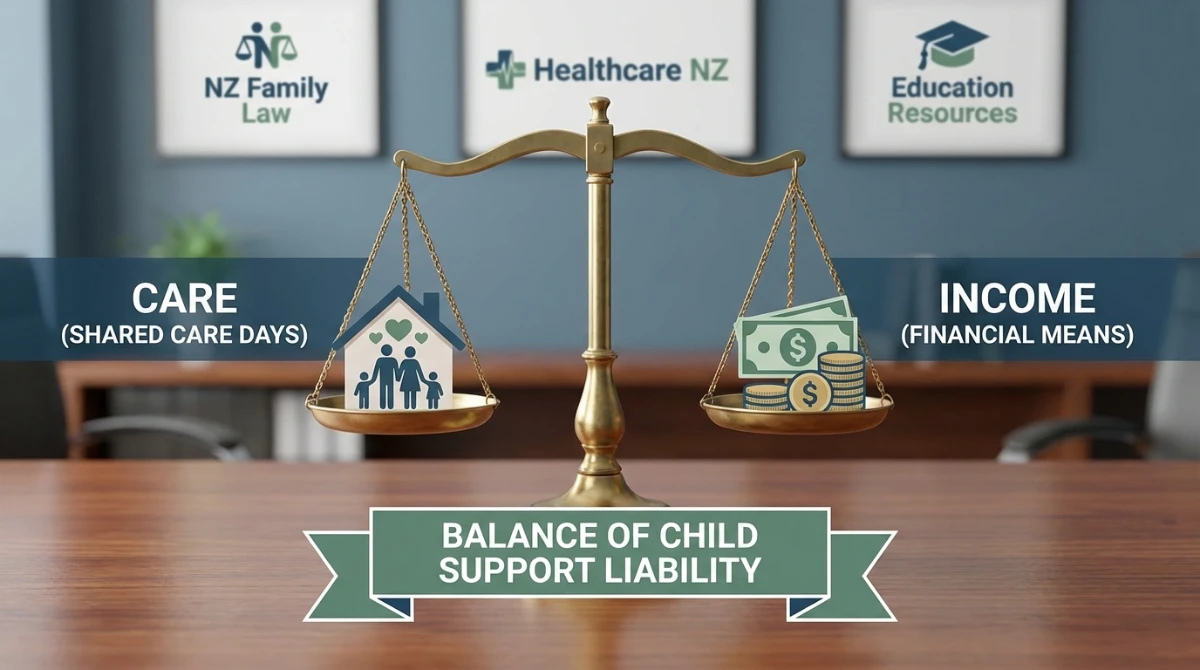
If a parent’s income percentage is higher than their care cost percentage, they are deemed the liable parent and must pay the difference to the other parent (or the state, in cases of government assistance). This formula ensures that the financial burden is shared proportionally to the wealth of the parents and the physical care provided.
Essential Variables Required to Calculate Child Support Liability
To accurately calculate child support liability, several specific data points must be retrieved from your financial records. The process is not merely about gross salary; it incorporates various ‘LSI entities’ such as fringe benefits, investment returns, and trust distributions that might otherwise be overlooked.
- Taxable Income: Your gross income as reported to Inland Revenue for the preceding tax year.
- Living Allowance: A fixed amount set annually by the government, intended to cover the parent’s basic costs of living before child support is deducted.
- Number of Dependent Children: Any other children the parent is legally responsible for, which can reduce the available income for child support.
- Prescribed Amount: The minimum amount of child support payable by law, even if income is very low.
- Expenditure on Special Needs: Provisions for children with disabilities or specific health requirements.
It is important to note that the Child Support Act 1991 is the primary legislation governing these variables. Any changes to this act directly impact how the software used by Inland Revenue executes these calculations.
Understanding Adjusted Taxable Income
When you attempt to calculate child support liability, the term “Adjusted Taxable Income” (ATI) will appear frequently. This is arguably the most critical component of the formula. ATI is not always identical to the figure on your tax return. For many New Zealanders, especially those who are self-employed or have complex investment portfolios, the IRD may include ‘add-backs.’
Add-backs often include items like certain types of trust income or company profits that haven’t been distributed as salary but are effectively available to the parent. The goal of the ATI is to reflect the ‘true’ financial capacity of a parent to provide for their child. If you have significant overseas income or receive tax-free allowances that are not captured in standard PAYE data, you are legally required to disclose these to ensure the liability calculation is fair and legal.
Living Allowance and Multi-Group Calculations
A significant factor used to calculate child support liability is the Living Allowance. For the 2024/2025 period, these allowances are adjusted based on the Consumer Price Index (CPI). If a parent has a new partner or other biological children living with them, the living allowance might increase, thereby decreasing their child support income. However, the system is designed to prioritize the children of the original relationship, so the allowances for ‘new’ family units are strictly capped.
Multi-group assessments occur when a parent has child support obligations for children in different families. This is one of the most complex areas of New Zealand family law. In these scenarios, the formula splits the parent’s income across the different ‘groups’ to ensure that no single child is unfairly disadvantaged. Calculating this manually is nearly impossible for the average person, making the Inland Revenue Child Support Calculator an indispensable tool for parents in this situation.

The Role of Care Cost Percentages
In New Zealand, the amount of physical care you provide is directly translated into a percentage that offsets your income. When you calculate child support liability, the IRD uses a ‘Cost of Children Table’ which assigns a value to the child based on the combined income of the parents. This value is then divided according to the care percentage.
- Less than 28% Care (0-102 nights): This is considered ‘limited care,’ and the parent is generally not credited with any offset for the costs of raising the child.
- 28% to 34% Care (103-127 nights): This is ‘regular care.’ The parent receives a care cost percentage of 24%.
- 35% to 47% Care (128-174 nights): This range progressively increases the care cost percentage.
- 48% to 52% Care (175-189 nights): This is ‘shared care,’ where the care cost percentage is set at 50%.
Misrepresenting care levels is a common source of legal friction. It is advisable to keep a ‘care diary’ or use a digital calendar to track nights spent, as the IRD may request evidence if one parent disputes the care levels reported by the other.
Challenging an Assessment and Administrative Reviews
There are times when the standard formula to calculate child support liability produces a result that is genuinely unfair. For instance, if a parent has high costs in exercising contact with a child (e.g., expensive domestic flights between Auckland and Christchurch), the formula might leave them with insufficient funds to live on. In such cases, a ‘Departure from Formula’ can be requested.
The administrative review process is the first step in challenging an IRD assessment. An independent review officer will look at the financial circumstances of both parents. Grounds for a review include:
- The capacity of the parent to provide support is significantly reduced by special circumstances.
- The costs of maintaining the child are significantly affected by the child’s high needs.
- The assessment does not take into account the high costs of travel to see the child.
- The assessment is unfair because of the income, property, or financial resources of either parent.

Impact on Healthcare and Education Resources
Child support is fundamentally linked to the ‘Healthcare and Education’ pillars of New Zealand society. While child support payments are intended to cover the general costs of school uniforms, books, and basic medical visits, they do not always cover private education or specialized healthcare treatments. For many families, these are negotiated as ‘Extraordinary Expenses’ outside of the standard IRD calculation.
New Zealand’s public healthcare system (Te Whatu Ora) and the public education system provide a safety net, but parents often find that the calculate child support liability process needs to be supplemented by a Voluntary Agreement to cover things like orthodontics, private tutoring, or sports academy fees. A Voluntary Agreement is a written contract between parents that is registered with the IRD, allowing for a more customized approach to child-rearing costs than the standard formula allows.
Furthermore, receiving child support can affect your eligibility for various Work and Income (WINZ) subsidies. It is crucial to understand how child support income interacts with Working for Families tax credits and other social security benefits to ensure your total household budget remains sustainable.

Conclusion and Key Takeaways
Mastering the ability to calculate child support liability is an essential skill for any parent navigating the New Zealand legal and financial landscape. While the IRD’s formula provides a standardized approach to fairness, the nuances of income adjustments, care percentages, and living allowances require careful attention. By understanding the legislative requirements and utilizing the available resources, parents can ensure that their children receive the financial support they deserve while maintaining their own financial stability.
Key Takeaways
- The formula is based on combined parental income minus living allowances.
- Care percentages are determined by the number of nights a child stays with a parent; 28% is the minimum threshold for regular care recognition.
- Adjusted Taxable Income may include more than just your base salary, such as trust or company income.
- Administrative reviews are available if the standard formula produces an unjust result due to special circumstances like high travel costs.
- Child support interacts with Working for Families and other government subsidies, affecting your overall net income.
For more detailed information or to start your own assessment, always refer to official government portals or consult with a qualified family law practitioner in New Zealand.