Accommodation Supplement NZ: The Definitive Guide to Eligibility and Support
Understanding the accommodation supplement NZ is essential for families and individuals seeking financial relief for housing costs in today’s volatile market. Whether you are renting, boarding, or paying off a mortgage, this non-taxable payment from the Ministry of Social Development (MSD) can provide a critical safety net. This guide explores the intricate details of eligibility, regional variations, and application processes to ensure you receive the support you deserve.
Table of Contents
- What is the Accommodation Supplement NZ?
- Who Qualifies for the Accommodation Supplement NZ?
- Financial Thresholds: Income and Cash Assets
- Geographic Variations: Understanding Area 1 to 4
- How Housing Costs are Calculated
- The Application Process and Documentation
- Special Circumstances: Boarding and Students
- Conclusion and Key Takeaways
What is the Accommodation Supplement NZ?
The accommodation supplement NZ is a weekly payment that helps people cover their rent, board, or the cost of owning a home. Managed by Work and Income (a service of MSD), it is designed as a targeted intervention for those who spend a disproportionate amount of their income on housing. Unlike some other forms of social assistance, the supplement is available to a broad demographic, including those in full-time employment, provided their income remains below certain thresholds.
The amount you receive is not a flat rate. Instead, it is calculated based on a complex formula that takes into account your income, your assets, your family status (whether you have a partner or children), and specifically where in New Zealand you reside. The logic behind this is to reflect the massive disparity in housing costs between major metropolitan hubs like Auckland and Wellington compared to more affordable rural districts.
Who Qualifies for the Accommodation Supplement NZ?
Eligibility for the accommodation supplement NZ is determined by several core factors. It is important to note that you do not need to be receiving a core benefit (like the Jobseeker Support or Sole Parent Support) to qualify for this payment. It is a standalone entitlement that supports working New Zealanders as well.
To be eligible, you must generally meet the following criteria:
- Be aged 16 years or older.
- Be a New Zealand citizen or permanent resident who is ordinarily resident in New Zealand.
- Not be living in a social housing property (Kāinga Ora or other Community Housing Providers where rent is income-related).
- Meet the income and cash asset tests.
- Have accommodation costs that exceed a certain threshold of your income.

Financial Thresholds: Income and Cash Assets
The Ministry of Social Development applies a rigorous means test to determine both eligibility and the final payment amount. The test consists of two main pillars: Income and Cash Assets.
The Cash Asset Test
Cash assets include money in the bank, shares, bonds, and other forms of liquid capital. It does not include the home you live in or your primary vehicle. As of current regulations, the limits are:
- Single Person: $8,100 maximum in cash assets.
- Married/De Facto Couple or Sole Parent: $16,200 maximum in cash assets.
If your total liquid assets exceed these figures, you are considered to have enough personal resources to manage your housing costs without government intervention.
Income Limits
Income limits are more fluid and depend on your family situation and the region in which you live. MSD calculates your “entry threshold”—the amount of housing cost you are expected to pay yourself before the supplement kicks in. Generally, the supplement pays 70 cents for every dollar of housing cost that exceeds this threshold, up to a maximum cap. Your weekly income (before tax) is then used to abate or reduce this payment if it exceeds certain levels.
Geographic Variations: Understanding Area 1 to 4
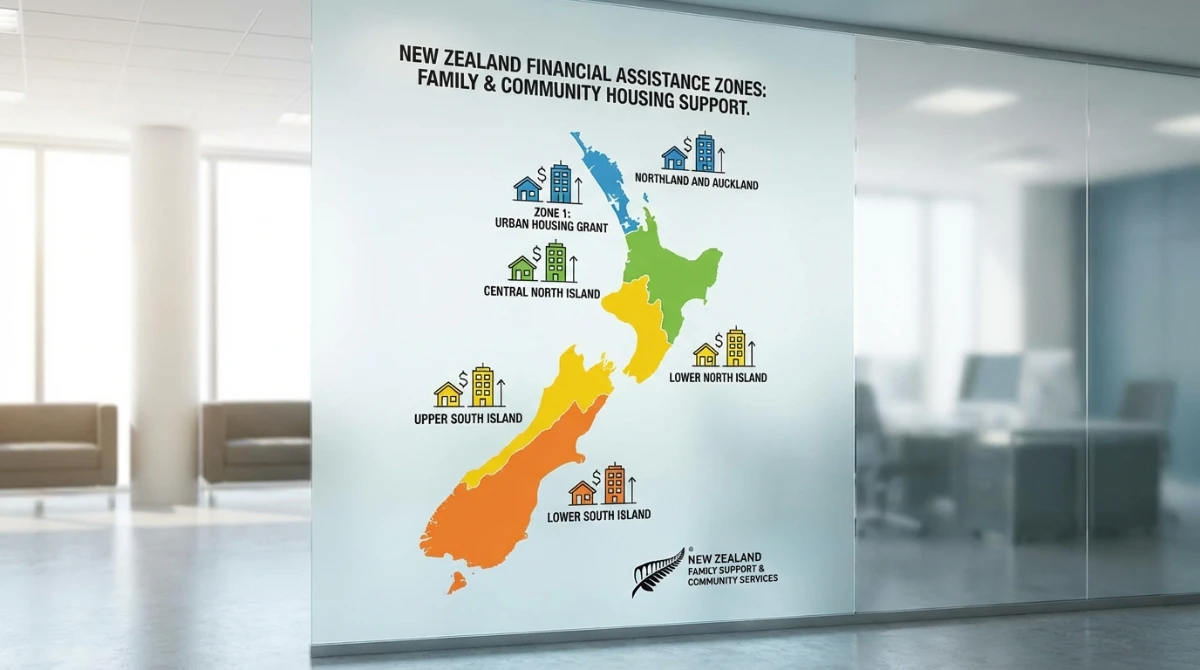
One of the most critical components of the accommodation supplement NZ is the regional classification. New Zealand is mapped into four distinct areas, which determine the maximum weekly payment you can receive.
- Area 1: Includes the Auckland region and high-cost urban pockets. These areas have the highest maximum payment caps to account for extreme rental and mortgage pressures.
- Area 2: Covers major cities like Wellington, Christchurch, Hamilton, Tauranga, and Queenstown Lakes District. The caps here are significant but lower than Auckland.
- Area 3: Includes smaller provincial cities and some suburban areas with moderate housing costs.
- Area 4: Encompasses the remainder of New Zealand, generally rural or small-town areas where market rents are traditionally lower.

How Housing Costs are Calculated
The definition of “accommodation costs” varies depending on your living situation. Accurate reporting of these costs is vital to ensuring your supplement is calculated correctly.
For Renters
If you rent your home, your costs are simply the amount you pay the landlord. You must provide a tenancy agreement or rent book as proof. Note that you cannot claim for utilities like electricity or internet unless they are bundled into a single, non-negotiable rent payment.
For Homeowners
Homeowners can include the following in their calculation:
- Mortgage interest (not the principal repayment).
- House insurance premiums (not contents insurance).
- Local authority rates (council rates).
- Water rates (if separate).
For Boarders
If you board with someone else, MSD typically considers 62% of your total boarding cost as your actual “accommodation cost.” This is because the other 38% is assumed to cover food and other utilities provided by the householder.

The Application Process and Documentation
Applying for the accommodation supplement NZ can be done online through the MyMSD portal or by booking an appointment at a Work and Income service centre. To ensure a smooth application, you should have the following documentation ready:
- Proof of identity (Passport, NZ Birth Certificate, or Driver’s License).
- Proof of bank account details for payment.
- Proof of income (latest payslips or a statement from your employer).
- Evidence of accommodation costs (Tenancy agreement, latest mortgage statement, or rates bill).
- A bank statement showing current cash assets.
Once submitted, MSD will review your application. If approved, payments are usually backdated to the date you first contacted them or submitted the application. It is your responsibility to inform MSD of any changes in your circumstances—such as a pay rise, a change in rent, or a new person moving into the house—as these will affect your entitlement.
Special Circumstances: Boarding and Students
There are specific rules for certain demographics that can complicate eligibility. For example, full-time students receiving a Student Allowance may also be eligible for an Accommodation Benefit through StudyLink. This is similar to the supplement but managed under different legislation. You cannot receive both the StudyLink Accommodation Benefit and the MSD Accommodation Supplement at the same time.
For those living with family, the rules around boarding are strict. If you live in a house owned by a parent or child, you may still be eligible for the supplement as a boarder, provided it is a genuine commercial arrangement and you are not a dependent. MSD may require a boarding declaration signed by both parties to verify the arrangement.

Conclusion and Key Takeaways
Navigating the housing landscape in New Zealand is challenging, but the accommodation supplement NZ serves as a vital tool for many households to maintain stability. By understanding the regional caps, income thresholds, and asset limits, you can better position yourself to receive the maximum support available. Remember that the system is designed to be responsive—if your rent increases or your hours at work are cut, you should immediately request a reassessment of your supplement.
Key Takeaways:
- The supplement is available to renters, homeowners, and boarders.
- You do not need to be on a benefit to qualify; working families are often eligible.
- New Zealand is split into 4 areas with different payment caps; Auckland (Area 1) has the highest support.
- Cash asset limits are $8,100 for singles and $16,200 for couples/parents.
- Applications are processed by Work and Income (MSD) and can be managed via MyMSD.
- Always report changes in income or housing costs immediately to avoid debt or underpayment.
If you are struggling with housing costs, do not hesitate to contact Work and Income or visit a local community budget advisor. The accommodation supplement NZ is a right for those who meet the criteria, providing the financial breathing room necessary to thrive in our communities.